Watson, Crick, Darwin and DNA
The Double Helix of DNA and why it matters.
Last month on November 6 James Watson passed away at age 97. Along with his colleague Francis Crick, Watson revealed to the scientific community the structure of DNA. Today DNA is a familiar term, but in 1953 this revelation was to set biology on a new path of understanding the nature of life. At that time scientists believed that DNA helped to pass on heredity traits to the next generation but were stymied about how.
How did DNA do this? The problem was solved when Watson and Crick revealed the structure of DNA, the now famous double helix. The revelation answered certain questions but also provoked more questions as the implications of this discovery became apparent.
Deoxyribonucleic acid (DNA), has four nitrogen bases cytosine (C), guanine (G), adenine (A) and thymine (T) and along the double helix structure they are paired A with T and C with G. These four bases can be arranged in specific orders and because of this property they can convey information or a message. They are like a four-character alphabet. The information in DNA is part of a system to build proteins from amino acids. Now there is also an “alphabet” for amino acids, however it is comprised of twenty characters. How can these two “alphabets” connect? They can do so because the two work together like code, like the computer code that we are so familiar with today. Computer code using only two digits, 0s and 1s, can be used as code for our twenty-six-letter alphabet. The American Standard Code (ASCII) uses those two digits in this sequence to represent the letter A 100 0001. B uses this sequence 100 0010, and C 100 0011. So in species, DNA’s four letter code is able to instruct to another biological alphabet.
Why did this discovery create such a problem for the Darwinian view, or the Neo-Darwinian view, or the current majority view of biology? Two of the key features of these views of nature and biology are, there is no telos, no goal, nature is not trying to make a new helpful innovation for the creature. Nature is not trying to create a new species. And, because there is no goal, it means that the new innovation is simply the product of chance. In Darwin’s way, all species and new features of an organism come about by chance without any intention to create anything. The human species, (you yourself), are the result of a natural process that did not have you, your mom, and dad in mind. We could say that all of the amazing creatures in nature are nothing more than the result of stupendous mind-blowing good luck.
Now back to why this is a problem for Darwin’s view of nature. In a system that depends on coded instructions, chance will not get it done. The arrangement of the four bases of DNA must be arranged in a very specific order to accomplish the task of building a given protein, and proteins are the building blocks of life. Take Scrabble tiles. If you scattered your Scrabble tiles on a table you have the twenty-six letters of our alphabet, but as yet, no message, no instructions. But you can set about arranging the letters in a sequence to spell words and arrange the words to create a meaningful sentence. In Darwin’s view of nature there is matter and energy and random processes that must by chance hit upon the proper sequence of letters to create a message. But we know that your Scrabble tiles, if simply randomly shifted about, are not going to create meaningful sentences.
It has taken some years for the implication of the revelation of the structure DNA to settle on the minds of scientists, but as they have pondered how proteins are built, how an innovation for a new biological feature could arise, some scientists and philosophers have come to understand that there must be something outside of or beyond matter and energy and a random process to create a new species. To build something new in biology, we need information to tell us how and what to build. We need new instructions from DNA. A chance variation and another and another, will not be enough to build/create a new feature or to create a new and different species from the one now existing.
Now we have no experience of a random goalless process creating anything. The chair you are sitting on, the shoe on your foot, simple artifacts, are the process of intelligence working toward a goal. Contemplate more sophisticated artifacts, the car you drive, the home where you live, the airplane flying above, what are the chances of these coming into being with no intelligent agent behind them? You know the answer, none. No chance. No chance at all. Then contemplate that your body, as a system in biology, is far far more complex than the sophisticated airliner flying at 35,000 feet. And this same issue of a random purposeless process achieving a functional result applies also to biological systems. If there is no chance of a 747 coming together by chance, what chance that your body did? We have no experience of random systems producing functional artifacts, but we are not left clueless. Our experience tells us how such things come to be. Our experience shows us that a mind, an intelligence, is capable of creating new and functional things. DNA points to something beyond nature. In December 2004 Anthony Flew, a noted atheist philosopher, surprised and dismayed his fellow atheists by declaring he had left atheism for theism. For Flew the evidence of design in the universe, DNA part of that evidence, was simply too great to be ignored. Flew was the kind of thinker who would follow the evidence wherever it led. He said the evidence led to design. The evidence was impossible to deny. Furthermore, design in the universe meant there must be a designer in the universe. Darwin’s project was to show that a designer was not necessary for the origin of species. He endeavored to show that nature could mimic a designer, but no designer was needed. The design that we all see, he thought was only apparent. DNA is one of those features of the universe that says otherwise.
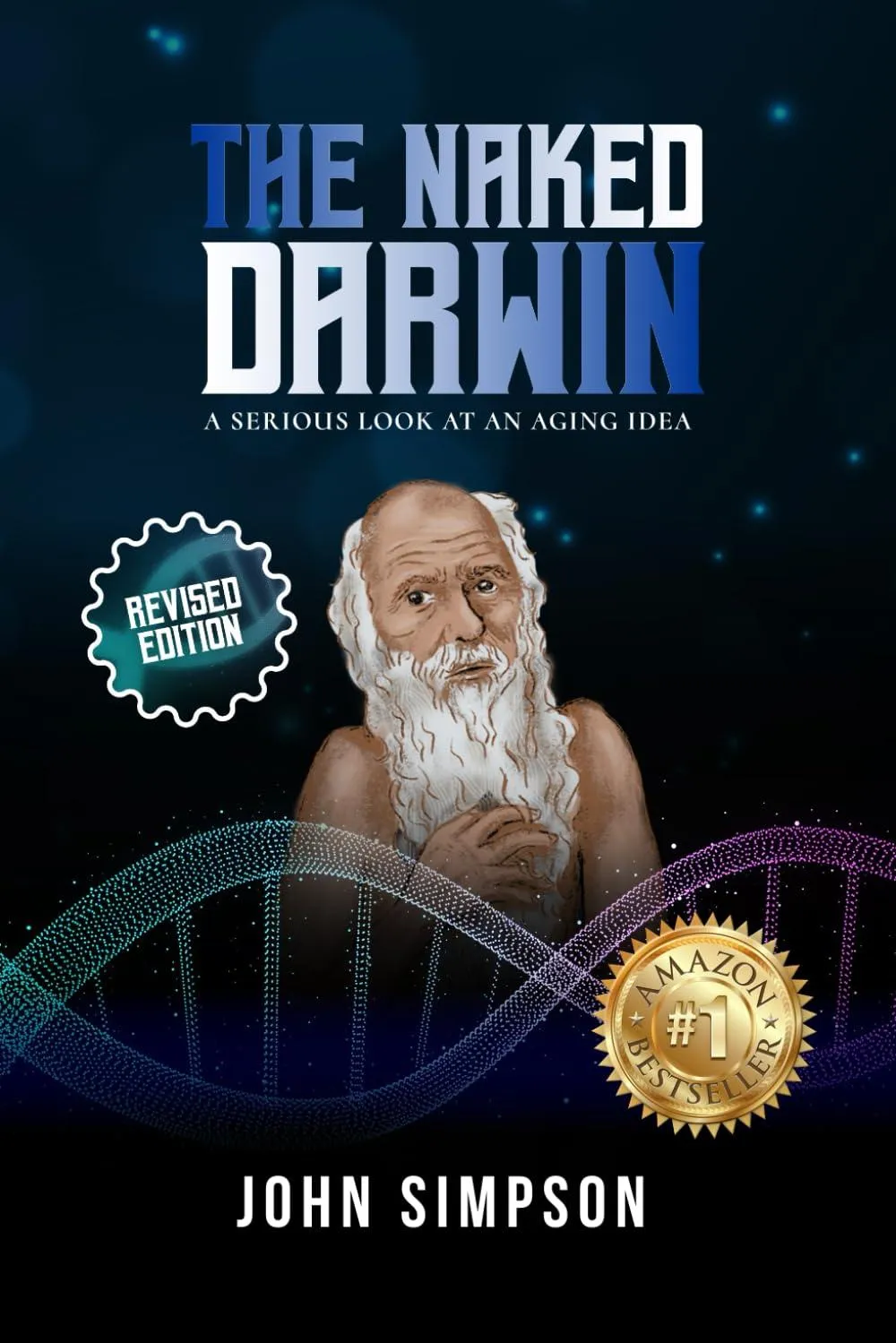
If you would like to know more about all of this, and other related issues, I encourage you to purchase The Naked Darwin. Thanks for reading and have a blessed holiday season.