Darwin's Conceptual Dilemma
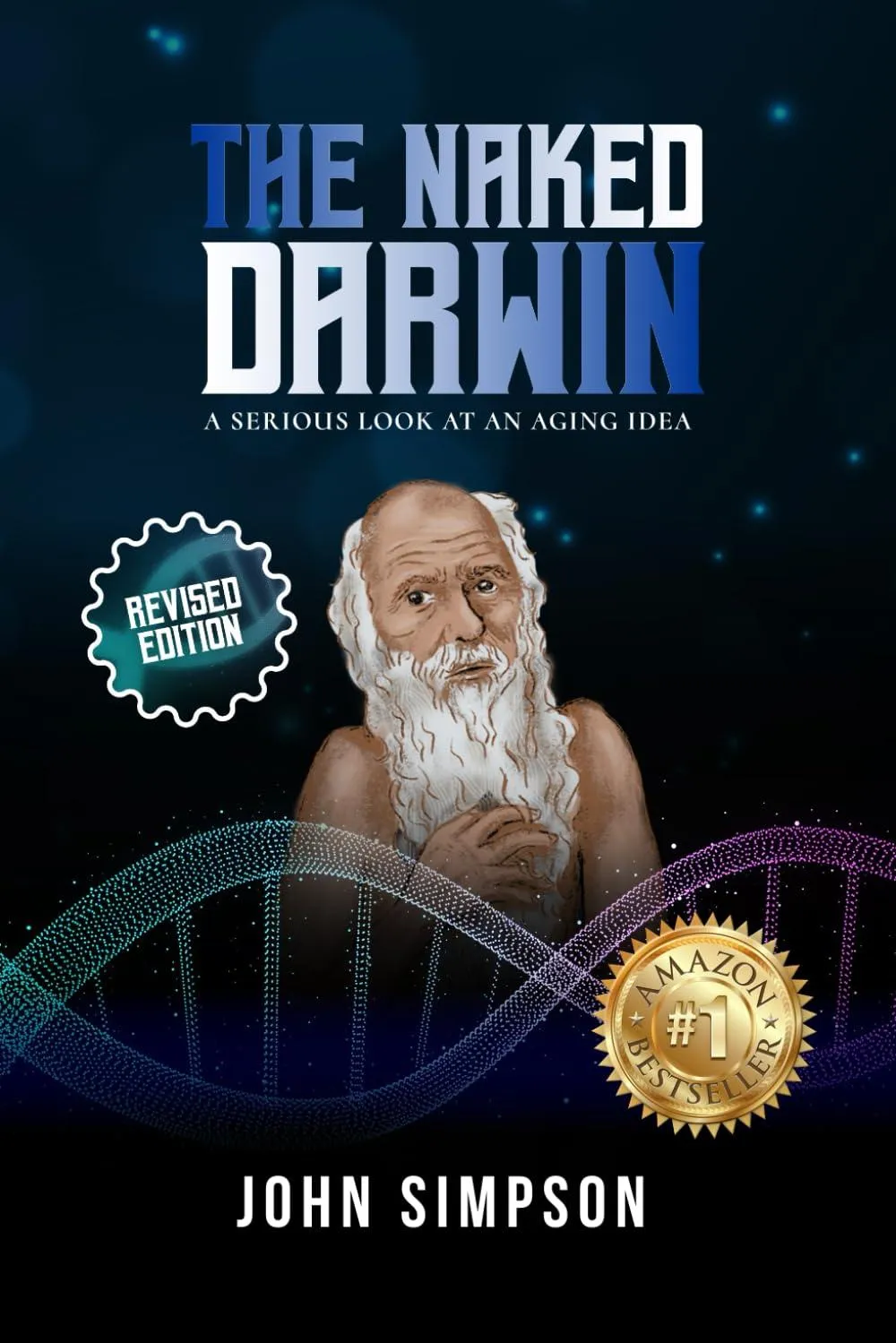
Here’s a question for you, did Darwin know what he was talking about? His most
famous book, The Origin of Species by Means of Natural Selection or the Preservation
of the Favoured Races in the Struggle for Life, published in 1859, underwent six
subsequent editions. With each edition Darwin worked to answer his critics. These
critics were not outraged clerics or angry folks in the pew, but his fellow naturalists. In
working to meet the many objections edition after edition, he had to make so many
retreats that his “baby” natural selection was much hollowed out by the end of this
process. But natural selection was Darwin’s gift to those looking for a scientific reason
to believe nature could make species with no need for the Divine. Natural selection is
the great term we associate with Charles Darwin.
In the mid nineteenth century, the zeitgeist was ready for, anxious to receive in fact, an
explanation of the origin of species that did not involve God. Darwin provides what so
many were so wanting with his “baby” natural selection. Ah, nature, all on her own,
works like animal breeders, those who select traits for sheep or for dogs. Working
gradually over millions of years natural selection creates new species. God is out of the
picture. Nature, without any goal, gets the job done. It was important for Darwin that
there be no teleology in the process. Nature has no goal. The process is blind. Nature
is not trying to build anything. Nature is not trying to create anything. This blind, hit-or-
miss, process just happens to produce lions, tigers and bears, you, your grandmother
and your Labrador Retriever. But right in the heart of Darwin’s “baby”, the word “select”.
Oh boy! Selecting means to be choosing; choosing among options, for a reason (a
goal?). Uh oh, selecting has smuggled in the teleology that his “baby” was intended to
eliminate.
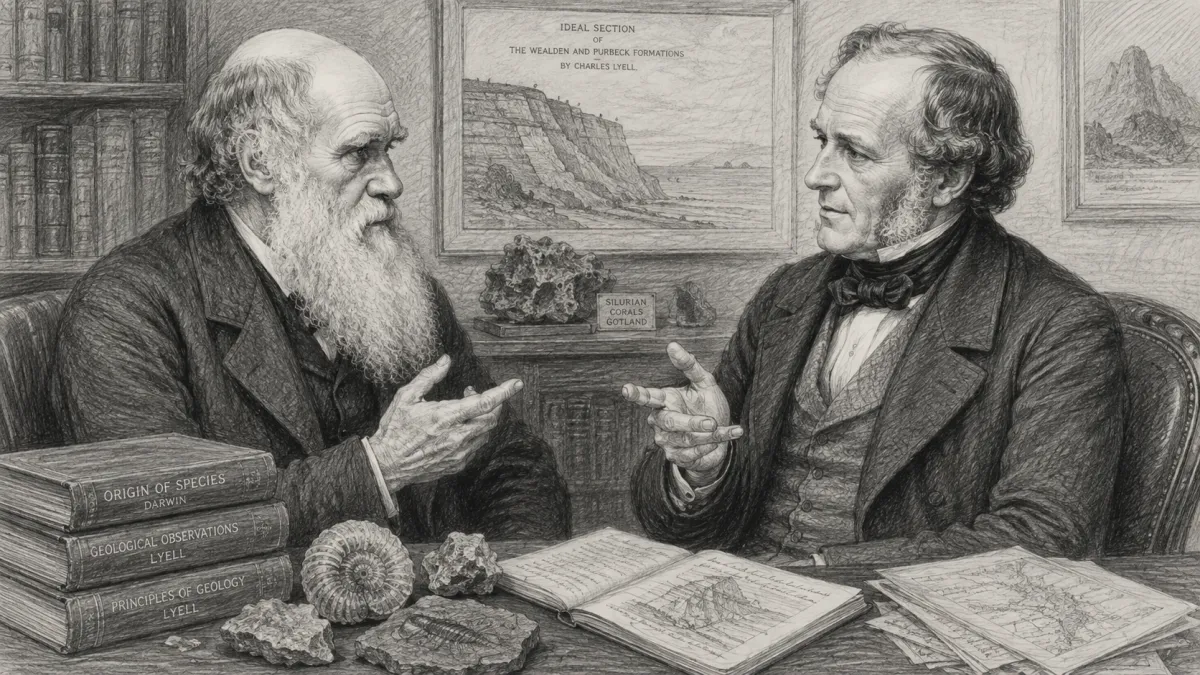
Charles Lyell (1797-1875), who wrote a seminal work on geology, had a profound
influence on Charles Darwin. Darwin was reading Lyell’s book during his voyage on
HMS Beagle. Lyell posited that the features of our Earth were not the result of
catastrophic events in the past. Rather, the Earth looked as it did because of processes
in operation that we observe now, and these processes had very slowly, over vast
amounts of time, created mountains, lakes etc. Lyell offered uniformitarianism as the
key to understanding our Earth, not events like Noah’s flood. Uniformitarianism would
be a gift to Darwin. He would posit that if nature had millions of years to act, gradual
changes in biological forms could render new species by small incremental stages
much like Lyell’s view of changes on our Earth. But Lyell would disappoint Darwin.
Lyell did not believe that the process he described for things inanimate could be
transferred to living organisms. For Darwin, not receiving Lyell’s blessing, but instead
his objection, counted as a real blow.
In a letter to Lyell in September 1860, Darwin told him, “Talking of ‘Natural Selection’ if I
had to commence de novo, I would have used natural preservation.” This is striking.
His book was published in 1859 and a year later he is questioning his “baby” natural
selection. But ‘natural preservation’; preservation preserves, it doesn’t get you a new
species, it does not advance any biological feature. So here, at the very heart of the
revolution that Darwin started, is a problem with the very term that was Darwin’s great
gift to all in the nineteenth century wanting a scientific reason to believe in evolution.
The inventor of natural selection is regretting his “baby”, and so we know at the heart of
Darwin’s thinking was his own confusion, or his own inability, to understand what he was
trying to say. He thought he had eliminated teleology from the origin of species, but it
turned out when he closely examined his own term, he had not. It turned out that there
wasn’t a way to have nature achieve new species with a blind hit-or-miss process.
Teleology could not be even conceptually eliminated from the process. Darwin’s own
struggle with his own term, natural selection, showed this to be the case.
Today, well into the twenty-first century, science still cannot tell us what brings about
new species. In their book What Darwin Got Wrong authors Fodor and Piattelli-
Palmarini, ask this rhetorical question of scientists today: “So if Darwin got it wrong,
what do you guys think is the mechanism for evolution?” Their answer: “We don’t know
what the mechanism of evolution is”. It turns out, neither did Charles Darwin.
[I am in debt to Neil Thomas, from his book False Messiah (2025), for the insights that
went into this blog post. His early work, Taking Leave of Darwin, is not to be missed.
Neil Thomas is a longtime member of the British Rationalist Association]