What Newton and Einstein Can Teach Us
If the project we call science is working the way we think it should be, questioning the
status quo when appropriate, being open to evidence no matter where it leads, working
to confirm a hypothesis, then the reaction by scientists to two figures in history provides
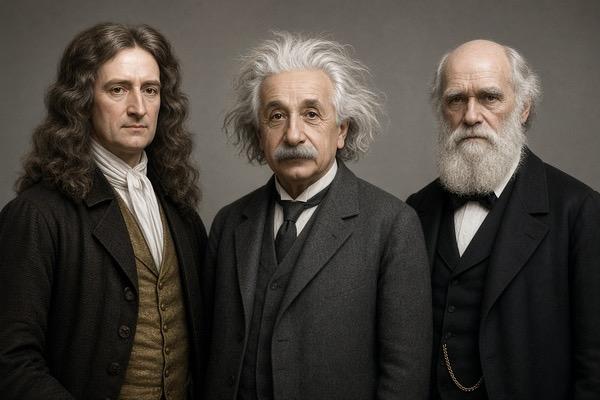
an instructive counterpoint worth considering. I want to consider Newton, Einstein and
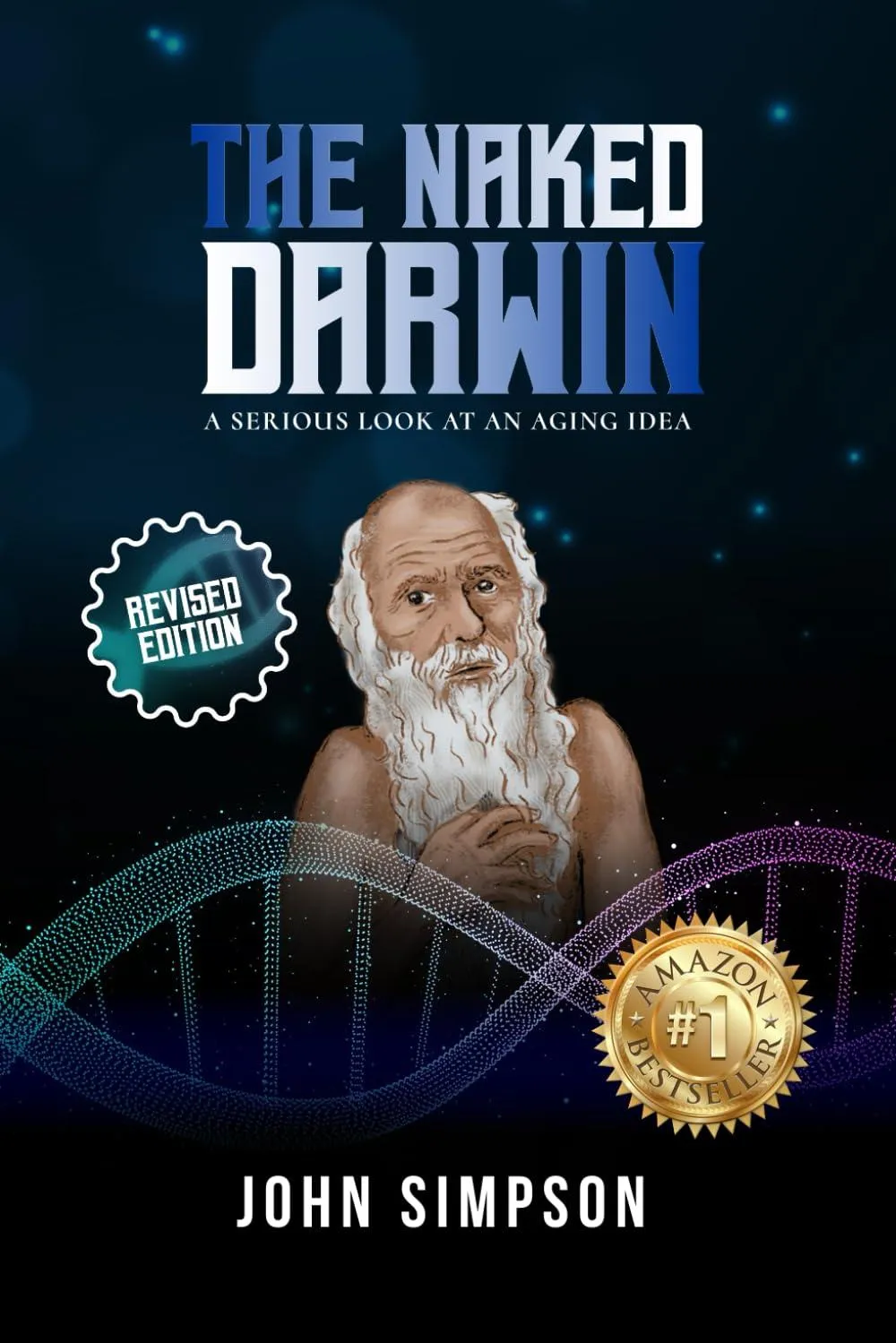
Darwin.
Isaac Newton (1643-1727) has a deservedly renowned place in the history of science. I
will not give an inventory of his amazing legacy regarding laws of motion, calculus,
gravity etc., it is not necessary. We all know that name. His achievements in science
rank as some of the greatest any mind has ever produced, and he is the first scientist to
be buried in Westminster Abbey.
Newton’s conceptions in physics remained solidly in place until the early part of the
twentieth century. His laws regarding motion were thought to be reality. But that view of
reality was about to be challenged. In a patent office in Bern Switzerland Albert Einstein
was wrestling with the contributions of another thinker from across the English Channel,
the Scot James Clerk Maxwell. Among Maxwell’s great achievements was his
unification of electricity and magnetism. As Einstein worked to make things fit with
Maxwell’s discoveries, he was coming to the realization that Newton’s legacy was due
for revision.
Here is a snapshot of what was coming. Einstein postulates that the laws of physics are
the same for all frames of reference, same for a person standing still as for another
person who is moving. The speed of light, 186,000 miles per second, is constant, the
same for both frames of reference. Given these two postulates when measuring events
then something must change. Time. Time, Einstein concludes, must not be constant.
Time changes, or as we use the word attached to this theory, time is relative. That time
is relative is part of his theory of special relativity that came from papers he wrote in
1905. His theory of general relativity came later in 1915.
Einstein was shaking up the world of physics and had many scratching their heads.
Could this man with no high academic standing be correct? And what of the legacy of
the great Isaac Newton lying in Westminster Abbey and his vaunted place in science.
Well, you know what followed. Scientists from around the world rallied to Newton’s
defense. His ideas on motion were near sacred, and scientists all needed to put this
upstart patent clerk in his place. So, scientists went about defending Newton’s ideas at
any and all costs and doing all they could to denigrate the upstart on the continent.
Besides ideas like time itself being relative, that is simply out of place in science. If
Newton’s ideas should be shown to be questionable in any way, then science itself is at
risk!
Actually, that was not the reaction of scientists, puzzled though they were; over the
years scientists did what we want scientists to do, they worked honestly grappling with
his theories. Einstein helped by doing what we want a scientist to do who is challenging
the status quo. Einstein had proposed some extraordinary ideas, but he was very
confident, and in the papers for his theory of general relativity (1915-1916) he proposed
a test. (It is one thing to theorize, and another to see if the theory works out in the
world.) Einstein had postulated that the mass of our sun would bend starlight by 1.75
arcseconds! There you go, a flat-out prediction based on his theory and his
calculations. In 1919 there was a solar eclipse. Because the sun’s light would be
blocked for about 5 minutes it would be possible to photograph bent starlight, if indeed it
did bend, and determine the degree that it bent. An expedition led by Arthur Eddington
was mounted. Photographic equipment was placed on Principe Island off the west
coast of Africa and in Sobral Brazil. The sun’s light is blotted out, the photos are taken,
and whataya know, Albert was right! His prediction confirmed, his theory confirmed.
When the results were announced to the Royal Society in England in November 1919,
Einstein became famous, at least for a while.
But this little essay is about a counterpoint. The above provides an example of how we
think science should get it done. A man sees a problem with current views of the laws of
physics. He proposes a different conception. Offers a test case. His ideas are
confirmed, but just as importantly, his theory was at risk of refutation. Charles Darwin
(1809-1882) proposed ideas about the origin of different animal species that challenged
the majority view of his day. In his day his ideas are accepted by some and not by
others. In his case, however, he did not propose a test for his argument. There was
one place to go, however, to confirm that there were innumerable transitional forms
leading up to present day animals: the fossil record, but the forms were not there.
Skeptics went to the fossil record to see the transitional forms. They could have said, in
some sense, this is our test for your new ideas on origins. Well, as Darwin had already
conceded in his book, the forms were not there. The fossil record did not contain
innumerable transitional forms. The theory was not confirmed by the one place that it
could be. But this is not the only counterpoint to Einstein’s revolution. As challenges
mounted in the late twentieth century to Darwin’s views on evolution, many scientists
rallied around Charles Darwin and his ideas. Unlike Newton, for some reason, Darwin
must be defended.
This posture by so many in the natural sciences to always rally to the defense of
Darwinian evolution is the counterpoint to the reaction of physicists to Einstein’s ideas.
In the one case scientists behave like scientists and in the other like priests defending
doctrine. There are times the tone of the defenders sounds like the defense of a sacred
figure rather than a scientist. A sort of, “how dare you?” strikes the questioner. And no
matter the evidence that figures against Darwin’s ideas, that evidence never counts.
Philosopher Karl Popper was one of many who noted that the “theory” of evolution was
no theory at all because it explained everything. Where science saw evolving species,
it was confirmed, if a creature remained unchanged for all time, well that was evolution
working just as well. We see change over time; evolution is at work. We do not see
change over time; evolution is at work. Einstein had proposed a test that could have
landed a blow to his theory. For Darwinian evolution, there is no test and no possibility
of refutation. Take it on faith that though there are problems galore, the theory is not to
be questioned. And that, I submit, is not how science should operate.